RAV4 or Land Cruiser Prado? Choosing the Right Vehicle for Self-Drive Safaris in Rwanda and Uganda
Self-drive safaris in East Africa give travelers freedom that guided tours cannot. You set your own pace, linger at a viewpoint longer than planned, and decide when to leave the main road. The vehicle you choose shapes that experience more than most people expect. For self-drive in Rwanda and Uganda, the two most common choices are the Toyota RAV4 and the Toyota Land Cruiser Prado. Each has clear strengths, and the right pick depends on your route, your passengers, and how much unpaved driving you plan.
Why the Vehicle Matters
Rwanda and Uganda share a region of excellent paved highways and rugged backcountry. Kigali, Musanze, and the main roads to Kampala and the Ugandan border are smooth. Once you turn toward Akagera’s lesser tracks, Nyungwe’s forest roads, Murchison Falls’ park circuits, or Kidepo Valley, conditions change quickly. Potholes, washboard gravel, steep grades, and seasonal mud are common. A vehicle that feels perfect on asphalt can feel fragile on a wet track.
Ground clearance, suspension travel, tire quality, and drivetrain all matter. So does the cost of hiring, fuel consumption, and whether you need space for luggage and camera gear. Thinking through these factors before booking will save you money and stress.
The Toyota RAV4: Efficient, Comfortable, and Easy to Drive
The RAV4 is a compact crossover built on a car-style platform. Its ride is smooth, its handling is confident, and its fuel economy is far better than a full-size SUV’s. Many travelers find it ideal for couples or small families who want to cover long distances on good roads without paying for capability they will never use.
Its limitations are real, though. Ground clearance is modest for the class, and most RAV4s are not designed for serious off-road use. A well-maintained RAV4 can handle graded dirt roads and the gravel approaches to lodges, but it can struggle on deep ruts, steep wet slopes, or washed-out sections. Its all-wheel-drive system helps with traction on loose surfaces, but it lacks the low-range gearing that makes a truck-based 4×4 controllable on steep, slippery ground.
The RAV4 suits travelers whose itinerary centers on Kigali, Lake Kivu, the Volcanoes National Park road, Kampala and Entebbe, and the sealed highways between them. It is also a sensible choice when budget is a priority and the group is small.
The Land Cruiser Prado: Built for the Track
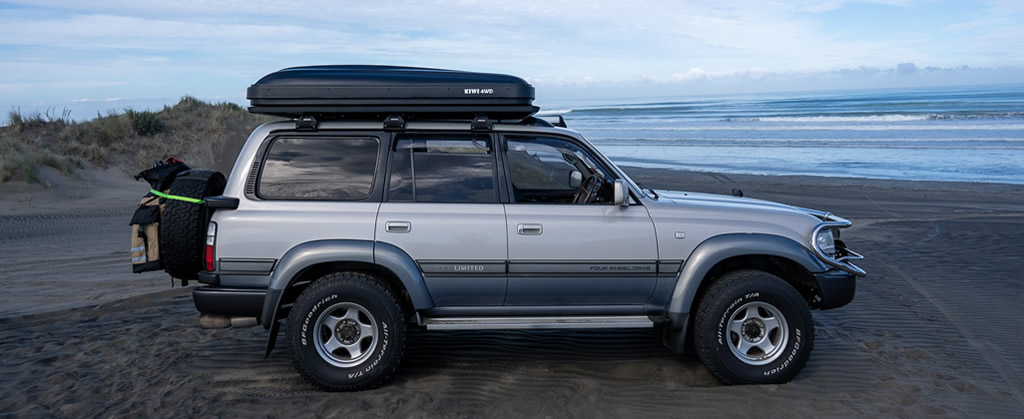
The Land Cruiser Prado is a body-on-frame 4×4 with a proper part-time four-wheel-drive system and low-range gearing. Its higher ground clearance, stronger suspension, and robust drivetrain make it far more forgiving on rough tracks. Drivers can creep down steep, muddy descents with confidence and power through soft sections that would stop a crossover.
The trade-offs are cost and consumption. The Prado typically costs more to hire and uses noticeably more fuel. It is also a bigger vehicle, which can be harder to park in crowded Kampala or Kigali. For travelers who will spend much of their time on unpaved roads, these costs are often justified by safety and peace of mind.
The Prado is the better choice for Murchison Falls, Kidepo, the more remote parts of Queen Elizabeth National Park, and any itinerary that includes wet-season travel or steep forest roads.
Route-by-Route Guide
Kigali and Akagera National Park. Kigali’s roads are well maintained, and the drive east to Akagera is largely paved. Much of the park’s internal road network is gravel and can be sandy or corrugated. For a short trip focused on game drives, a RAV4 with good tires is usually adequate, though the Prado gives more margin if the park’s tracks are in poor condition.
Volcanoes National Park and Musanze. The road from Kigali to Musanze is paved and in good shape. The final approach to trailheads and some lodges can be steep and muddy after rain. Either vehicle works in dry season. In the wet season, the Prado is the safer option.
Nyungwe Forest. The main road through the forest is sealed, but many internal roads and viewpoint tracks are narrow, steep, and slippery. Travelers focused on canopy walks and chimpanzee trekking will feel more comfortable in a Prado, particularly if the weather has been wet.
Kampala, Entebbe, and Lake Victoria. Urban driving in Kampala is demanding because of traffic, motorcycle taxis, and congested junctions. A smaller vehicle such as the RAV4 is easier to maneuver. The highways out of the city are generally good.
Murchison Falls National Park. Murchison Falls is the classic case for a 4×4. The park’s game tracks, river crossings, and sandy sections demand higher clearance and robust drivetrains. A Prado is strongly recommended here.
Bwindi and Queen Elizabeth. The roads toward Bwindi can be rough and steep, with mud after rain. Queen Elizabeth’s tracks vary from good gravel to deep ruts. Choose the Prado if you plan to explore beyond the main routes.
Kidepo Valley. Kidepo is remote, and its roads demand serious preparation. Hire a Prado, carry spare fuel and water, and consider hiring a local driver guide who knows the terrain.
Cross-Border Self-Drive Trips from Rwanda
Many travelers combine Rwanda and Uganda in one trip, and cross-border self-drive is entirely practical. The main crossing is at Gatuna (Katuna on the Ugandan side), which is well trafficked and typically efficient. Kigali to Kampala is a long day’s drive on good roads, and most travelers break the journey in Kabale or at Lake Bunyonyi.
Before crossing, confirm several things with your rental company. Ask whether the vehicle is authorized for cross-border travel, and get written confirmation. Verify that insurance covers both countries, and ask what documentation you need at the border. Carry your driver’s license, an International Driving Permit if your license is not in English, your passport, and the rental agreement. Requirements can change, so check current rules with the company and official sources before you travel.
Both countries drive on the left, which means you should expect to drive on the left side of the road. Hold on, that is incorrect: Rwanda and Uganda both drive on the left, so plan your driving accordingly and allow extra time when adjusting to the road.
Practical Tips for Booking
Whether you choose self-drive or a car with a driver guide, read the rental terms carefully. Self-drive arrangements usually involve a deposit, a fuel policy, and mileage limits, and some companies restrict travel to certain parks or regions. Ask about roadside assistance and whether the company can provide a replacement vehicle if something goes wrong far from town.
A “car hire and driver guide” package is a strong option for first-time East African travelers or anyone uncomfortable with unfamiliar roads. The driver knows the terrain, handles border paperwork, and can point out wildlife you might miss. The cost is higher, but the experience can be more relaxed and informative.
If you search for “safari car hire in Rwanda” or “Uganda 4×4 car rentals,” compare vehicle condition, insurance coverage, and reviews from recent travelers. A well-maintained vehicle with good tires matters far more than the badge on the hood.
Making Your Choice
Choose the RAV4 if your trip centers on paved roads, you are traveling light, and your route stays near Kigali, Musanze, Lake Kivu, and Kampala. Choose the Land Cruiser Prado if you plan to visit Akagera’s tracks in poor condition, Nyungwe’s steep forest roads, Murchison Falls, Kidepo, or any region during the wet season. When in doubt, take the Prado. The extra cost buys confidence, and confidence is what makes a self-drive safari enjoyable.
Whichever you choose, plan your route honestly, leave time for the unexpected, and enjoy the freedom of exploring two of Africa’s most beautiful countries at your own pace.